
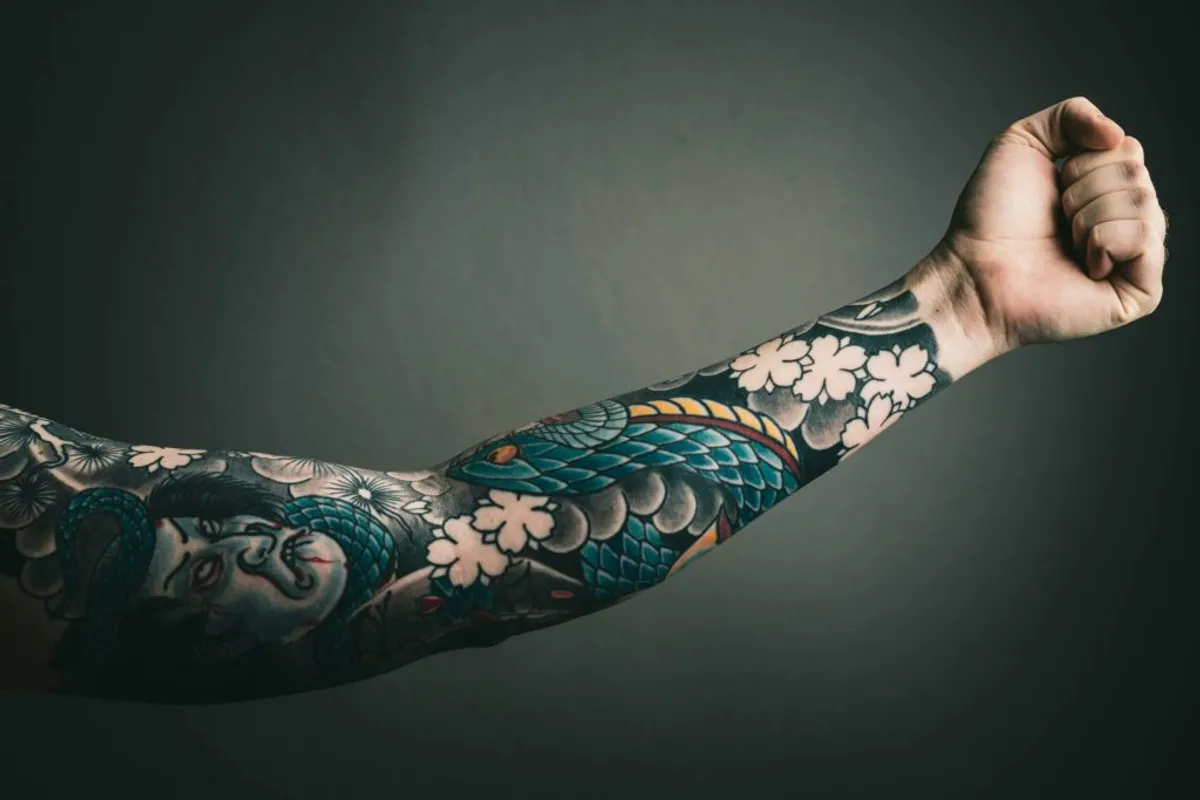
Irezumi is the traditional Japanese form of tattooing: large designs that follow the contours of the body, featuring koi carp, dragons, tigers, cherry blossoms and waves, where each motif has a specific meaning and a precise place. It is one of the richest and most demanding styles in existence, with a history as beautiful as it is eventful.
If you thought a koi carp was just a goldfish that’d made it big, you’re in for a surprise.
Where does irezumi come from?
A long history, not always a glorious one
Tattooing has existed in Japan for a very long time, with its purposes having changed significantly over the centuries: as decoration, as a spiritual mark, but also, at certain times, as a form of punishment inflicted on convicts in the form of visible marks. It is from this complex history that the figurative and ornamental style now known as irezumi emerged.
The prints that changed everything
In the 19th century, during the Edo period, the painter Utagawa Kuniyoshi published a series of woodblock prints dedicated to the heroes of Suikoden, a popular novel. In these prints, his warriors are depicted covered in spectacular tattoos. According to Nippon.com, these images had a profound influence on irezumi: dragons, tigers and legendary heroes moved from paper to skin, and the large, full-body tattoo became an aesthetic ideal.
Banned for over seventy years
In 1872, the Meiji government banned tattooing, deeming it incompatible with the modern image Japan wished to project to the world. The ban remained in place until 1948. Throughout this period, irezumi survived in the shadows, which reinforced its association with the fringes of society, particularly with the yakuza.
Recent recognition
The year 2020 marked a significant turning point: the Japanese Supreme Court ruled that tattooing was not a medical procedure, thereby putting an end to legal proceedings against tattoo artists accused of practising medicine without a licence. A victory for the entire profession, and another step towards what we champion at Tat’s It: the recognition of tattooing as an art form in its own right.
What is tebori?
Tebori is the traditional manual technique. The tattoo artist uses a long handle fitted with needles and works the ink into the skin using rhythmic movements, without a machine. It takes years to master the technique, and requires stamina on both sides of the needle.
The technique is renowned for its solid colours and shading of particular depth. Today, many tattoo artists combine machine work with hand-stitching, depending on the stage of the process. An irezumi created entirely by machine is by no means illegitimate: what defines irezumi is, first and foremost, its composition and symbolism.
What do the major irezumi designs mean?
| Design | Main meaning | Role in the design |
|---|---|---|
| Koi carp | Perseverance, strength in the face of adversity | Central design, often featuring waves |
| Dragon | Wisdom, benevolent strength, protection | Central design for large pieces |
| Tiger | Courage, protection against evil spirits | Main or secondary design |
| Cherry blossoms | Transient beauty, impermanence | Connecting element, rhythm |
| Waves and clouds | Water, air, movement | Grid linking all the elements |
| Heroes and deities | Loyalty, integrity, protection | Central motif, often drawn from legends |
The koi carp
It stems from a legend of Chinese origin, which was adopted in Japan: the carp that manages to swim up a waterfall transforms into a dragon. Hence its most classic depiction, swimming upwards amidst powerful waves. It embodies perseverance, and is one of the easiest designs to adapt to a medium-sized tattoo.
The dragon
Forget the European dragon that guards a treasure and sends knights fleeing. The Japanese dragon embodies wisdom and protection, and is associated with water and wind. Its long, supple silhouette makes it the ideal design to wrap around an arm or across a back.
The tiger
A symbol of courage and protection against evil spirits, the tiger is often associated with the wind or bamboo. It is sometimes paired with the dragon, with the two forces complementing one another from one part of the body to another.
Cherry blossoms
Sakura celebrate the beauty of a fleeting moment. It’s a lovely paradox for a tattoo, which makes the most ephemeral of flowers permanent. In large designs, they link the main motifs and add rhythm.
Waves and clouds
They are the unsung heroes of irezumi. They form the framework that connects all the elements, fill in the spaces and guide the eye along the curves of the body. Without them, a large piece would look like a collection of stickers.
How is an irezumi design created?
This is what really sets irezumi apart from a simple Japanese design. The body is not seen as a series of separate areas, but as the canvas for a single composition. Large pieces, an entire back, a whole arm, or sometimes almost the entire body, follow a precise logic:
- a striking central motif, often a dragon, a carp, a tiger or a hero;
- accompanying secondary elements, such as flowers, leaves and animals;
- a background of waves, clouds or wind, which brings the whole design together and connects the different sections.
This hierarchy is not merely decorative: every element has a meaning and a place. A tattoo artist trained in irezumi handles this grammar almost like a language, which explains why this style requires extensive and specialised training. To compare it with other major styles, see our overview of tattoo styles.
Why is irezumi still frowned upon in Japan?
This is because more than seventy years of prohibition and the association with the yakuza have left their mark. Even today, many onsen, traditional hot springs, refuse entry to people with visible tattoos, and some companies remain very strict about visible tattoos.
The paradox is striking: irezumi is admired worldwide as the pinnacle of tattoo art, yet it remains frowned upon in its own country. Attitudes are changing, particularly amongst young people and in the big cities. But if you’re travelling to Japan with a visible tattoo, do check before visiting public baths: some establishments allow it, others offer to cover it up, whilst others refuse entry.
This tendency to judge a person by their tattoos is something we’re familiar with in France too, albeit in other forms. It’s one of the reasons behind Tat’s It, and we discuss this in our article on tattoos in the workplace.
How can we approach irezumi with respect?
Irezumi has spread throughout the world, driven by the beauty of its designs. There’s nothing to stop you from getting one even if you’re not Japanese, provided you take it seriously:
- find out about the meaning of the designs you choose;
- Avoid a patchwork of Japanese motifs chosen solely for their appearance;
- Choose a tattoo artist trained in this style, who can explain each element to you.
It is this approach that allows irezumi to travel the world without losing its depth.
Where should you start if you’re tempted by irezumi?
There’s no need to commit to a full-back design straight away. Many large designs start with a medium-sized piece, and this is often the best way to get a feel for the style.
Start with a small, complete design. A carp swimming through waves on the forearm, a tiger and bamboo on the calf, a bouquet of peonies on the shoulder: these pieces already form a coherent whole, with a main motif and its background, without taking dozens of hours.
Think about the long term right from the start. If you envisage a full sleeve one day, let the tattoo artist know. They’ll position the first piece and arrange the waves or clouds so that it can be extended naturally, rather than being stuck in the middle of your arm.
Choose the area based on the design. Irezumi follows the contours of the body: a dragon works best on large, curving areas, whilst a carp is better suited to a more elongated area. Our guide to tattoos by body area helps you visualise the possibilities.
Make sure you look after your tattoo between sessions. A large tattoo involves several stages of healing. Our week-by-week healing guide explains what to expect at each stage.
How do you choose a tattoo artist who specialises in irezumi?
This is even more crucial than for other styles. Take a look at their portfolio with these criteria in mind:
- complete designs, not just individual motifs ‘inspired by Japan’;
- photographs of designs at various stages, to assess the composition;
- photos of healed tattoos, to see how the colours and backgrounds hold up;
- A genuine exploration of symbolism during the consultation, not merely a juxtaposition of designs.
And, of course, the basic requirements that apply to all tattoo artists: hygiene training, registration with the ARS, a dedicated studio, and single-use equipment. Our guide to finding a tattoo artist in Paris sets out the method in detail, which can be applied to any city.
In terms of budget and timing, a large irezumi takes months, sometimes years, to complete, session by session. Our guide to tattoo prices will help you plan ahead.
Find out more
An irezumi is a lifelong project, undertaken with a tattoo artist who understands every aspect of the art form. To find certified tattoo artists near you and browse their designs before getting in touch, download Tat’s It, the 100 per cent free app: the links are just below.
An idea, a tattoo, Tat’s It.