According to the French National Health Insurance, a tattoo takes 3 to 4 weeks to heal on the surface and several months to heal completely. During this time, your skin does all the work. Your job is mainly to leave it alone, which becomes surprisingly difficult around the tenth day, when it starts to itch.
At Tat’s It, we know this subject all too well. A few years ago, Léo, one of our team, had a tattoo done at home by someone who’d only just bought their tattoo machine. The healing process was complicated, the result was a disaster, and he had to pay around a hundred euros to have it touched up by a proper tattoo artist. This guide is the one he would have liked to have read beforehand. Here, step by step, is what’s normal, what isn’t, and the techniques that make all the difference.
How long does it take for a tattoo to heal?
Three to four weeks for the visible part, a few months for the hidden part. Here is the typical process, which we’ll go into in more detail below:
| Period | What you see | What you do |
|---|---|---|
| First few hours | Red, swollen, painful area | Follow the tattoo artist’s instructions regarding the dressing |
| Days 1 to 3 | Clear oozing, sometimes tinged with ink | Shower, mild soap, pat dry |
| Days 4 to 7 | Thin scabs, tight skin | Leave the scabs alone |
| Week 2 | Itching, flaky skin | You tap, you don’t scratch |
| Weeks 3 and 4 | Dull, hazy, “milky” appearance | You wait, without panicking |
| More than a month | The design regains its contrast | It protects against the sun and moisturises |
Healing times vary depending on the area, the size of the design and your skin. As the French National Health Service points out, healing times are “variable depending on the area tattooed”. A small design on the forearm will heal more quickly than a large piece on the ribs or the foot.
Days 1 to 3: why is the tattoo oozing?
Because a tattoo is a wound. The needle has deposited ink beneath the surface of your skin, and your skin reacts just as it would to any superficial injury. Immediately after the session, the area is red, swollen and painful for a few hours. Afterwards, it oozes a clear fluid, sometimes slightly tinted with ink. This is normal, and it subsides day by day.
This is also the time when aftercare is most important. The National Health Service’s list of recommendations can be summarised in a few simple steps:
- wash your hands with soap before each treatment;
- Remove the plaster and start looking after the tattoo as advised by the tattoo artist;
- Leave the tattoo exposed to the air as much as possible, unless otherwise advised by the tattoo artist;
- Shower using a mild, pH-neutral soap, then pat dry without rubbing;
- Apply the recommended antiseptic and, if necessary, a healing cream, without putting a plaster over it.
Here’s a little-known fact: your tattoo artist must give you an information sheet on aftercare. If you leave without one, ask for it. It’s your instruction manual for the next four weeks, and it’s worth more than any advice you might find in the comments under a video.
For these three days, your arm might look a bit like a sandwich wrapped in cling film. The look is debatable, but the method works.
Days 4 to 7: should you pick at the scabs?
No. Never. Not even a tiny bit.
Around the fourth day, thin scabs form on the areas that have been worked on the most, particularly where there are solid blocks of colour or a lot of black. The skin feels tight, and the design looks uneven, sometimes slightly raised. All of this is normal.
The rule is simple: scabs fall off on their own. If a scab is picked off too soon, it can take pigment with it, leaving a lighter patch once the tattoo has healed. In fact, the French National Health Service lists ‘picking at scabs or dead skin’ amongst the things to avoid. A scab is like a spoiler: it’s tempting, and it spoils everything.
If it happened by accident (a jumper pulled on too quickly, a restless night), clean the area gently, resume your usual aftercare routine and wait until the healing process is complete before making a judgement. A small, lighter patch can be easily corrected with a touch-up.
Week 2: how can you soothe the itching without scratching?
The second week is the worst. Your skin peels as if you’d been sunburnt, and it itches. A lot. It’s a sign that your skin is regenerating, so it’s actually good news, even if it doesn’t feel like it at 11 pm.
What really helps:
- tap the area with the palm of your hand rather than scratching it;
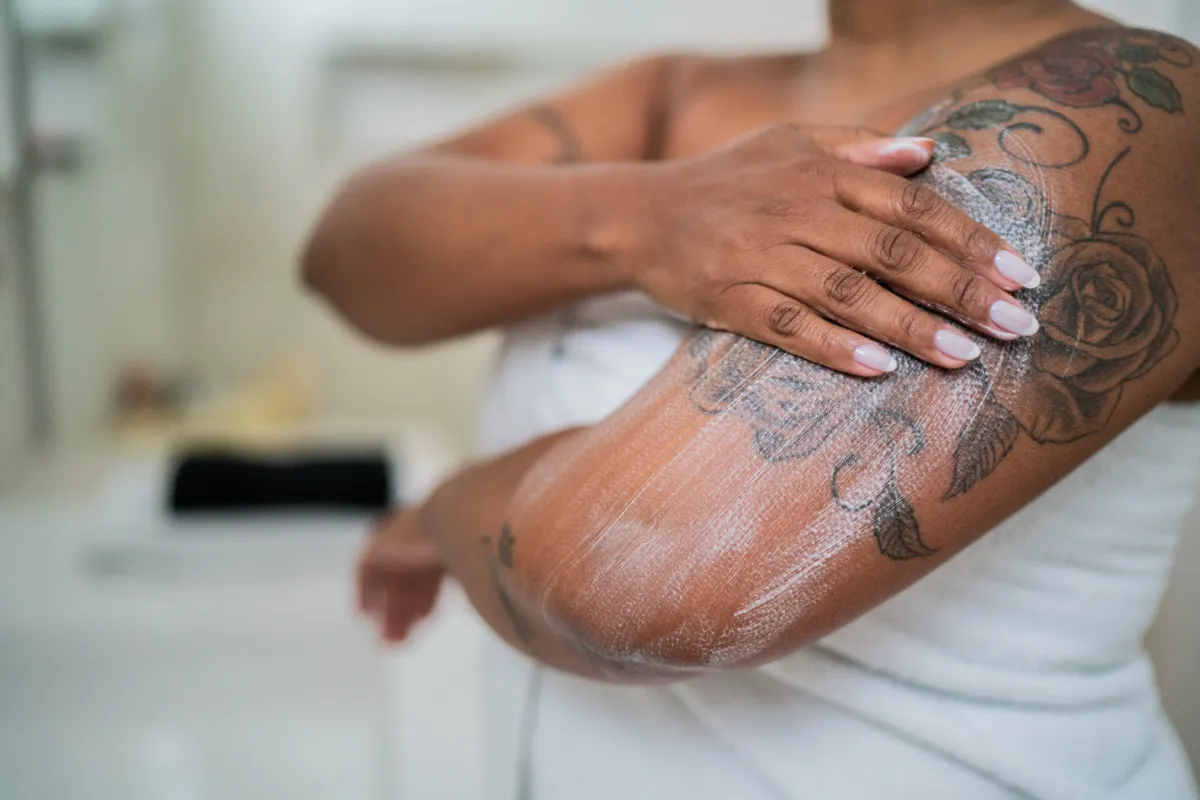
- Apply a thin layer of the cream recommended by your tattoo artist: the tattoo should remain visible beneath the cream, not completely covered by it;
- wear loose-fitting cotton clothing, as recommended by the French National Health Service, and avoid wool and synthetic fabrics that rub against the skin;
- Avoid situations where you sweat excessively: hold off on intense exercise for a few days, especially if the tattoo is in a crease.
Normal itching is widespread and subsides over the course of a few days. If it is concentrated on a single colour of the design, or on raised areas or small patches, keep an eye on it: we’ll discuss this further down, in the section on allergies.
Weeks 3 and 4: why does the tattoo look dull or milky?
This is the stage that causes the most panic, yet it is perfectly normal. Once the scabs and dead skin have fallen off, a new layer of skin covers the ink. It is still thin and slightly opaque, which gives the design a veiled, blurred appearance, as if viewed through a white film. The lines appear less sharp and the blacks less deep.
It’s neither a botched tattoo nor poor-quality ink. It’s simply the skin that hasn’t finished its work yet. Over the following weeks, it will lighten and the contrast will return.
The right thing to do: carry on with your aftercare, don’t try anything to ‘speed things up’ (no exfoliation, no stronger products), and don’t book a touch-up in a panic. If you’re in any doubt, send a photo taken in daylight to your tattoo artist. They’ve seen plenty of milky-looking tattoos and will be able to tell you at a glance whether everything is progressing as it should.
After a month: has the tattoo really healed?
On the surface, yes. But deeper down, not quite yet. The skin continues to regenerate for several months, and it is during this period that the final appearance settles. In practical terms, your tattoo is no longer a wound, but the skin has still been through a lot.
This is also a good time to discuss whether a touch-up is needed. An area that’s remained lighter, a slightly uneven line: your tattoo artist will tell you if it needs touching up, and when. Some tattoo artists include a touch-up in their price, provided it’s done within a certain timeframe. Ask about this during your session, and check out our guide to tattoo prices to find out what a quote should include.
In the long term, two simple habits are all you need: a standard moisturiser from time to time, and sun cream whenever you’re out in the sun. UV rays are the worst enemies of colours and fine lines.
Swimming, the pool, the sun: things we put on hold for a month
The French National Health Service provides a detailed list of actions to avoid whilst the tattoo is healing. Here they are, along with the reason behind each one:
| Best avoided | Until when? | Why |
|---|---|---|
| Les Bains | The first month | The wound is soaking in stagnant water |
| Swimming pool, sauna, damp areas | Until the tattoo has healed | Germs, chlorine, prolonged exposure to moisture |
| The sun | Until the tattoo has healed | Irritation, which can affect the pigments; if this is unavoidable, use a high-protection cream |
| Clothes that chafe | The entire healing process | They pick at the scabs and irritate the skin |
| Touching a tattoo without having washed your hands | The entire healing process | It’s a gateway for bacteria |
| Dust, dirty clothes | The entire healing process | A tattoo is a wound, so it needs to be looked after as such |
| Excessive sweating, bruises | The entire healing process | Irritation and a wound that has reopened |
| Alcohol, tobacco, drugs | The entire healing process | They slow down the healing process |
Showers are still permitted: they should be short, using mild soap, and the area should be dried thoroughly afterwards.
If you’ve planned to get a tattoo a week before your seaside holiday, we applaud your optimism. But you’d best postpone one or the other.
What cream should you use on a healing tattoo?
The one your tattoo artist has recommended. This isn’t just a trick: every tattoo artist has a method they’re familiar with, tailored to their way of working. Some apply a second-skin film to be worn for a few days, whilst others prefer the traditional method involving cleansing and cream. Both work, provided you stick to them.
The most common mistake is to change products every two days because “it’s not healing quickly enough”. The healing process follows its own rhythm, and no cream can speed it up. Trying out five products in a week essentially means subjecting your skin to five changes when it didn’t need any at all.
If you want to use a product that your tattoo artist hasn’t mentioned, ask them first. A ten-second chat is better than ten days of irritation.
The healing process begins before the session
This is the aspect that is least often discussed, yet it is the one that matters most. According to the French National Health Insurance, an infection following a tattoo can result from two things: a mistake made whilst caring for the tattoo at home, or a germ introduced during the session itself, via contaminated equipment, ink or disinfectant, when hygiene rules are not followed. In other words, you could follow every instruction in this guide to the letter and still experience complications with the healing process if the problem had already arisen beforehand.
That’s why we take such a firm stance against ‘scratchers’, people who buy a machine online and call themselves tattoo artists without any training. In France, tattooing requires compulsory training in hygiene and health standards, as well as registration with the Regional Health Agency. This isn’t just red tape: it’s what guarantees that the needle is sterile and that the workspace is clean.
Léo found this out the hard way: his first tattoo, done at home by an untrained beginner, healed badly and had to be redone. Our two other co-founders, one of whom went to a tattoo artist with a large following on Instagram and the other to the first studio they came across, also ended up seeing another tattoo artist for a touch-up. Three methods, three touch-ups. We do not recommend any of the three.
To avoid ending up in this situation, our article on warning signs to look out for before choosing a tattoo artist and our guide to choosing your first tattoo will tell you the right questions to ask. And on the Tat’s It app, you’ll only find certified tattoo artists: links to download it are at the bottom of this page.
Normal healing or infection: when should you see a doctor?
We are not doctors, and this guide is not a substitute for medical advice. However, here are the guidelines provided by the French National Health Insurance scheme, which will help you decide when to stop searching online and make an appointment.
| Pretty standard | Should alert |
|---|---|
| Localised redness that is gradually subsiding day by day | Redness extending beyond the design |
| A slight warmth for the first few days | Persistent or increasing heat |
| Clear oozing that is drying up | Thicker, yellowish or foul-smelling |
| Slight swelling during the first few hours | Significant swelling that is not subsiding |
| Itching in week 2 | Fever |
The procedure for claiming through the National Health Service involves two steps:
- If the area becomes red, painful and swollen, increase the frequency of disinfection as advised by your tattoo artist;
- If the infection persists, spreads around the tattoo or if you develop a fever, consult your GP. A course of antibiotics may be necessary.
Reactions that come later
Some complications do not appear during the healing process, but weeks or months later. According to the French National Health Insurance scheme, an allergy to tattoo ink is the most common complication, and it usually affects a single colour, typically red. It manifests as an itchy or swollen tattoo, or as patches of that colour on the skin. Certain skin conditions, such as psoriasis or vitiligo, can also flare up on a tattoo. In such cases, you should consult a dermatologist.
Report a problem
If you have experienced an adverse reaction following a tattoo, you can report it via the official reporting portal. The French National Health Insurance scheme also refers users to ANSES’s ‘Tatouvigilance’ programme, which monitors the risks associated with tattoo inks and tattooing practices. It only takes a few minutes, and it helps everyone enjoy getting a tattoo with greater peace of mind.
Why do some areas take longer to heal?
Because they move, rub or sweat more. Hands and feet are constantly in use; the areas where the skin folds (elbows, knees, ankles) stretch with every movement; and the areas covered by a belt, a shoulder strap or a shoe rub against the skin all day long.
In these areas, take extra care for a few days: wear loose-fitting clothes, shoes that don’t rub against the design, and limit contact with water and soil. Our pain map and our guide to tattooing by body area will help you plan for this before you even choose a spot. Style matters too: a design with lots of solid colour puts more strain on the skin than a fine-line tattoo, as we explain in our guide to tattoo styles.
Find out more
- A map of pain: which areas hurt the most?
- 7 warning signs to look out for before choosing a tattoo artist
Good healing is 50 per cent aftercare and 50 per cent patience. And, above all, 100 per cent a proper tattoo artist. To find one near you, download Tat’s It, the 100 per cent free app that lists only certified tattoo artists, from the App Store or Google Play: the links are just below. Until then, keep your hands in your pockets.
An idea, a tattoo, Tat’s It.