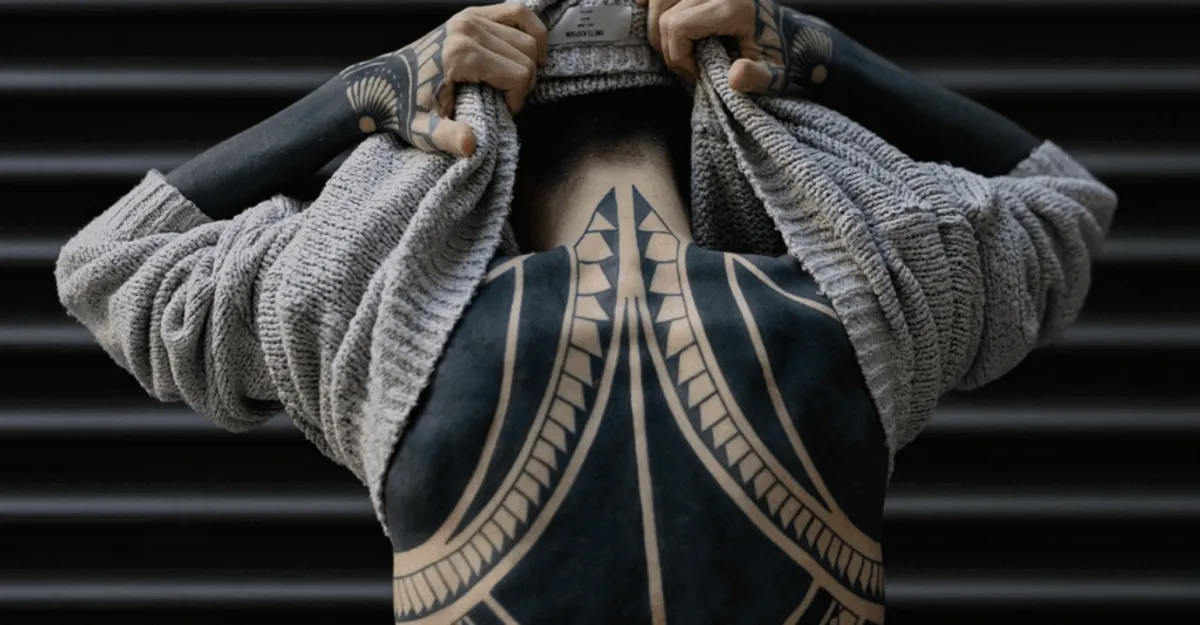
Blackwork is a style of solid black tattooing: dense, uniform blocks of colour, crisp edges, and no shading to soften the transition to the skin. It’s a style that takes the phrase attributed to Henry Ford about his cars quite literally: you can choose any colour, as long as it’s black.
Behind this radical image lies a very long history, a demanding technique and a range of sub-styles that is far more varied than it might seem. Here’s everything you need to know before you take the plunge.
Where does blackwork come from?
A tribal heritage
Large, dense black designs are nothing new. They have been found for centuries in various tribal traditions, particularly in Polynesia and Borneo, where large areas of skin were covered in black designs, created by hand using techniques passed down from generation to generation.
These tattoos were not merely decorative in the modern sense. They followed precise codes linked to social status, group affiliation or major life events. Each design had a specific place, a meaning and a rightful wearer.
Contemporary blackwork
The blackwork style seen today in Western tattoo studios has mainly developed since the 2000s. Tattoo artists have taken the aesthetic of maximum contrast and applied it to other graphic styles: geometry, ornamentation, lace, architecture and silhouette illustration.
Rich black ink remains the common hallmark. The range of designs, however, has expanded enormously. If a particular tribal design appeals to you, take the time to find out its original meaning before getting it: a tattoo always tells a story, so you might as well know what it is.
What technically sets blackwork apart?
Solid black. A perfectly uniform black surface, with no variation in shade, defined by crisp outlines. It’s simple to describe but difficult to get right.
To achieve an even black colour, the tattoo artist often has to go over the same area several times to avoid small, less saturated patches that would appear as lighter spots once the skin has fully healed. Maintaining this consistency from start to finish across a large area requires real skill.
| Style | How the black ink is applied | Result achieved |
|---|---|---|
| Blackwork | In solid, uniform blocks of colour | Striking, graphic contrast |
| Dotwork | By accumulating points | Texture, grainy shading |
| Black and grey | Dilutions for creating shades of grey | Soft shading, photo-realistic or pencil-style effects |
| Fineline | In very fine lines | Delicacy, lightness |
Many designs combine these techniques. A block of blackwork that flows into dotwork, for example, creates a very different effect to a block of blackwork on its own. Our overview of tattoo styles presents each one in detail.
What are the main styles of blackwork?
Contemporary tribal
It draws on the curves and motifs of Polynesian or Bornean traditions, without necessarily adhering to their original stylistic conventions. It is often a gateway to blackwork, and also the style that suffered the most during the 2000s. (The tribal tattoo on the lower back from that era deserves our sympathy, not our mockery. It did the best it could.)
Ornamental
Lace, mandalas, motifs from sacred architecture: ornamental designs often form symmetrical patterns, playing on the contrast between filled-in areas and patches of bare skin to allow the design to ‘breathe’.
Geometric designs
Precise lines, symmetrical shapes, interlocking figures. Created using flat colours rather than fine lines, it is utterly unforgiving: the slightest deviation from symmetry is immediately visible against a black background.
The blackout
The extreme version: an entire area of the body, such as a forearm or a sleeve, covered in solid black. It is sometimes used to cover up old tattoos that are no longer wanted. This is the most committed form of the style, both in terms of session duration and irreversibility.
Silhouette-style illustrations
A scene, an animal, a landscape, all depicted entirely as black silhouettes, without any internal detail. The power lies entirely in the outline and the shape. When done well, it is strikingly clear, even from a distance.
The abstract and the experimental
A more recent trend is reinterpreting the conventions of blackwork to create deliberately irregular compositions: organic shapes, stylised splashes and textures that play on variations in density. It is less a question of geometric precision than of a sense of composition, and this is where tattooing most closely resembles painting.
Why does blackwork age so well?
Because contrast stands the test of time. A rich, saturated black remains legible years later, whereas light colours or very subtle gradients may fade or blend together. This is one of the main arguments in favour of this style.
There are two conditions, however. Firstly, the ink must be well saturated from the outset: uneven black ink remains so, and this becomes even more noticeable over time. Secondly, the sun remains the enemy of all tattoos. Regular use of sun cream helps the black ink stay deep rather than turning a bluish-grey.
Pain and session duration: what to expect?
For the same area, a solid block of colour takes longer than a fine design, and filling in the area is generally perceived as more painful than outlining the contours, because the needle passes over the same surface for a long time. Our pain map remains the basis for choosing the area, but this factor must also be taken into account.
A full-sleeve or full-back ‘blackout’ tattoo is completed over several long sessions, spaced out to allow for the necessary healing time. The project takes months to complete, and the budget reflects this: ask during your consultation how the tattoo artist charges and whether they can give you a rough estimate. Our guide to tattoo prices will help you understand a quote.
How do you choose a tattoo artist who specialises in blackwork?
The portfolio says almost everything, provided you know how to read it:
- perfectly even solid colours, with no lighter patches or wobbly edges;
- Photos of healed tattoos, not just fresh ones. A glossy black image under plastic film hides a lot;
- Experience with large areas is essential if your design is large. Successfully executing a small geometric design does not guarantee the same consistency across an entire sleeve;
- designs on skin tones similar to your own, so you can see how they’ll look in real life.
And, of course, the basic requirements that apply to all tattoo artists: hygiene training, a registered business, a dedicated studio and single-use equipment. If you’re looking in Paris, our guide to finding a tattoo artist in Paris explains how to go about it.
A style that leaves little room for second thoughts
Blackwork is more permanent than other styles. A light colour is barely visible when applied over a solid black background, so adding colour on top later is virtually impossible. And a large, heavily inked piece usually requires numerous laser sessions to be faded, with no guarantee of success.
That’s no reason to rule out the style. It’s a reason to choose it with full knowledge of the facts. If you’re unsure, start small, live with your piece for a few months, and then let it grow. Many large blackwork designs started with a single motif on a forearm.
How do you prepare for a blackwork design?
A good blackwork design is planned before the consultation. Here are a few tips to help you arrive with a clear idea of what you want:
- Gather some examples of what you like: do you prefer geometric, ornamental, tribal or illustrative designs? The tattoo artist will be able to create a design that suits you, without copying someone else’s tattoo;
- Bear in mind both the area and the size. Blackwork needs space to breathe: a design that is too small and too busy loses its clarity, whilst a composition that is well-proportioned to the area has greater impact;
- Think ahead. If you ever plan to extend the design, let the tattoo artist know right from the start, so they can leave some space free and include connection lines;
- Plan ahead in terms of time and budget. A large design will take several sessions and several months. It’s better to know this before you start than halfway through;
- Plan ahead for the season. The weeks of healing don’t sit well with the height of summer, with all the sun, swimming pools and beaches. Starting your tattoo in the autumn gives you more peace of mind.
None of this requires you to have a design ready. The design is the tattoo artist’s job, and that’s where you really see that they’re artists.
Does blackwork go well with other styles?
Very good, provided the design remains legible. A solid colour that flows into dotwork, an ornamental motif edged with a delicate floral pattern, a black silhouette set against a black-and-grey landscape: these successful combinations maintain the power of contrast without overwhelming it.
The risk is trying to cram everything into one spot. An area that’s already very dark, overloaded with different elements, quickly becomes illegible from a distance. Ask your tattoo artist to show you some mixed designs they’ve already done: that’s the best way to judge whether they’ve got a good sense of balance.
Find out more
- 12 tattoo styles to choose from
- Irezumi, the traditional Japanese tattoo
- Tattoos: which areas hurt the most?
Blackwork doesn’t do things by halves, and that’s exactly why we love it. To find a certified tattoo artist who’s an expert in solid black work and view their healed pieces before messaging them, download Tat’s It, the 100 per cent free app: the links are just below.
An idea, a tattoo, Tat’s It.