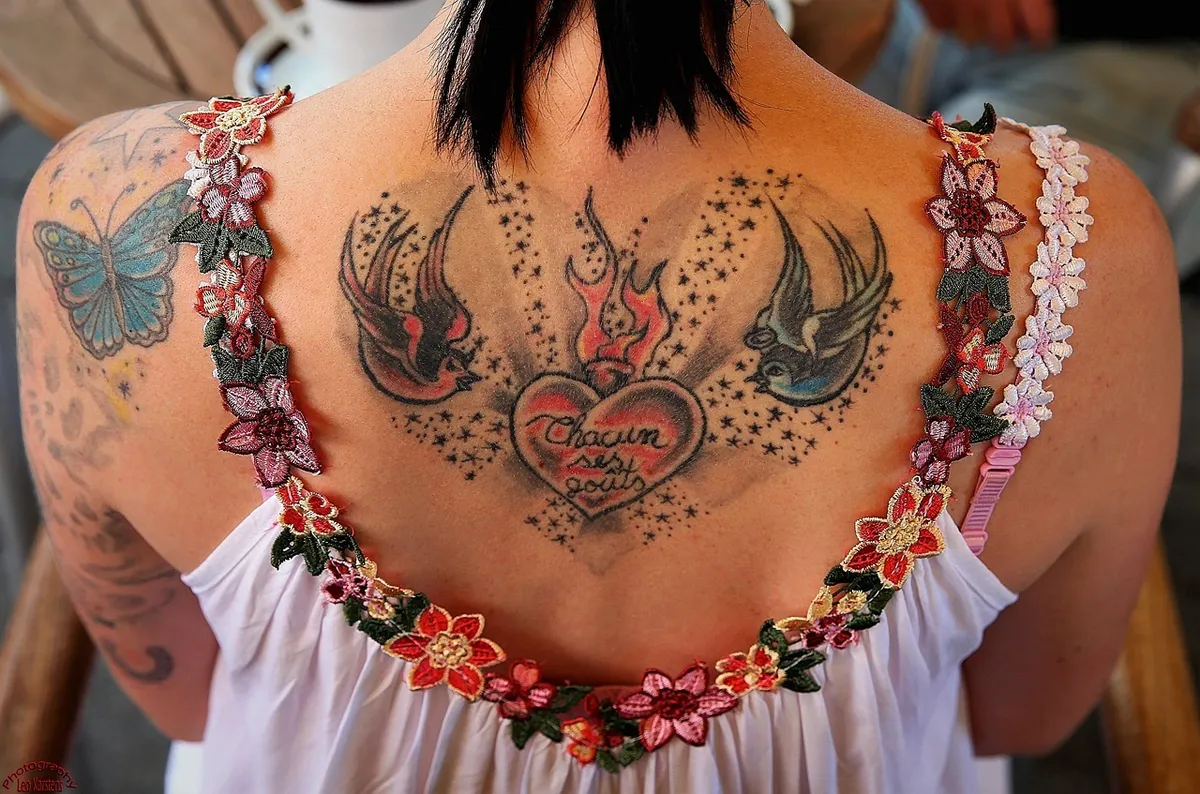
The areas that hurt the most when getting a tattoo are those where the skin is thin, close to the bone or highly innervated: the ribs, the sternum, the hands, the feet, the spine and the joints. The most comfortable areas are those with plenty of flesh, such as the outer forearm, the calf, the shoulder or the outer thigh. In between, it all depends on you, how you’re feeling on the day and the length of the session.
And no, there’s no such thing as a spot where “it doesn’t hurt at all”. Anyone who’s promised you that was either very brave or just trying to cheer you on so they wouldn’t be left on their own.
Does getting a tattoo really hurt?
Yes, a bit. The French National Health Service (Assurance Maladie) puts it quite plainly: tattoos are done without anaesthetic and they are painful. The tattoo artist must, in fact, inform you of the “potentially painful nature” of the procedure before starting, as Service Public points out.
The sensation is most often like a sharp, repeated scratch, or a mild, continuous burning sensation. On comfortable areas, many people describe it as uncomfortable rather than painful. On bony areas, the sensation becomes more dull, with a vibration that resonates through the bone. It’s not pleasant anywhere, but it’s bearable almost everywhere, especially when you know what to expect.
What makes one area more painful than another?
Three anatomical factors explain almost everything.
What lies beneath the skin. A layer of fat or muscle cushions the sensation of the needle. The thicker it is, the more bearable it is. That’s why the outer thigh is much more comfortable than the shin.
Distance from the bone. When the needle is working directly above a bone or joint, the vibration is transmitted directly. This applies to the ribs, sternum, collarbones, elbows and ankles.
Nerve density. The hands, feet, neck and face contain a huge concentration of nerve endings within a small area. This is very useful for feeling a caress, but far less so when it comes to having a needle inserted.
A map of body areas, from the least sensitive to the most sensitive
This ranking reflects the trends reported by tattooed people and tattoo artists. It’s a snapshot of current trends, not a prediction: your experience may vary, either way.
| Area | Overall impression | Why |
|---|---|---|
| Outer forearm | Quite comfortable | Muscle, with few bones close to the surface |
| Calf | Quite comfortable | Good muscle thickness |
| Shoulder, outer upper arm | Quite comfortable | Fleshy area |
| Outer thigh | Quite comfortable | Fat and muscle |
| Upper back, shoulder blade | Medium | Comfortable on muscle, sharper on bone |
| Inside of the arm, inside of the thigh | Moderate to sensitive | Thinner skin with a higher density of nerve endings |
| Nape of the neck, neck | Sensitive | Thin skin, numerous nerves |
| Inside of the wrist | Sensitive | Bones and tendons just beneath the skin |
| Elbows, knees, shins | Sensitive | Skin right down to the bone |
| Spine | Sensitive | A tingle down every vertebra |
| Hands, fingers, feet | Very sensitive | Lots of nerve, very little fat |
| Ribs, sternum | Very sensitive | Thin skin, bones, and the breath that sets everything in motion |
The ribs deserve a special mention. You breathe, and they move. The tattoo artist asks you not to move. You breathe anyway, because you can’t help it. Everyone gets the hang of it in the end, but it’s rarely the most relaxing session of the year.
To find out how each location ages and which design suits it best, our guide to tattoos by body area complements this map.
Why your experience won’t be the same as everyone else’s
The same tattoo, in the same place, can leave two completely different impressions. Several factors come into play, and most of them depend on you.
Stress
The more nervous you are, the more your body tenses up, and the more intense the sensation feels. It’s the classic vicious circle of a first session. Knowing exactly what’s going to happen helps to break this cycle: ask the tattoo artist to explain the steps (the stencil, the outlines, the shading) and how long each one will take.
Tiredness, hunger and thirst
A tired, empty or dehydrated body copes much less well with a tattoo session. This isn’t just a feeling: the French National Health Service points out that the pain of getting a tattoo can even cause fainting. An empty stomach is a major contributing factor.
Your own threshold
Some people naturally have a higher pain threshold than others, regardless of their gender or build. We all have in mind the image of the big, burly bloke turning pale as he gets a tattoo on his forearm, and that of the petite person getting one rib after another whilst chatting about the TV series they’re currently watching. Both exist, and neither has anything to prove.
The real risk isn’t the pain; it’s the discomfort
This is the aspect that’s often overlooked. You can cope with the pain. But the discomfort strikes when you least expect it: dizziness, cold sweats, blurred vision. It tends to affect people who arrive tired, on an empty stomach, or who are holding their breath without realising it.
To avoid this:
- Have a proper meal a few hours beforehand, but don’t over-eat either;
- drink water before and during the session;
- Take a sweet snack with you for long sessions;
- Breathe slowly, especially during the trickier parts. Holding your breath tenses up your whole body;
- Let someone know straight away if you feel dizzy. It’s better to lie down for two minutes than to fall over.
And avoid alcohol the day before and on the day itself. Most tattoo artists refuse to tattoo someone who has been drinking, and the National Health Service lists alcohol amongst the factors that slow down healing. So, a drink to pluck up courage ends up costing you twice as much.
Do style and technique affect the level of pain?
Yes, and we rarely think about it. Drawing a fine, continuous line doesn’t feel the same as filling in a solid black area, where the needle goes over the same surface again and again. Filling in, shading and gradients are often perceived as more painful than outlines, because they put prolonged pressure on the same area.
A fine-line tattoo on the forearm may therefore prove easier than a small solid-colour design in the same area. Conversely, a large, full-coverage blackwork tattoo requires more stamina than courage. Ask the tattoo artist how they plan to proceed: knowing that the filling-in stage is due in an hour, and that it will last twenty minutes, makes the experience much easier to get through.
How do you manage a long session?
After three hours, the difficulty is no longer really the intensity of the pain, but the fatigue that builds up, the position you’ve been holding for a long time and the area becoming more sensitive with each pass. A few habits help a great deal:
- regular breaks, requested before you’re completely exhausted;
- Distractions: music, podcasts, conversation. Focusing on something other than the needle really changes your perception of time;
- A comfortable position: if your arm goes numb or your leg feels tight, a slight adjustment is often all it takes;
- Several sessions rather than just one for large designs, with the necessary healing time between sessions.
Anaesthetic creams? This is something to discuss with your tattoo artist before your appointment. Some allow them, others do not. These are active products: ask your pharmacist or doctor for advice before using one, and never apply it without telling your tattoo artist first.
And after the session, does it still hurt?
A little, for a few hours. According to the French National Health Insurance, immediately after getting a tattoo, the area is red, swollen and painful for a few hours. The sensation is similar to that of a severe localised sunburn: hot, tight and sensitive to touch. It subsides quickly, giving way over the following days to skin that feels tight, then itchy in the second week.
Pain that gets worse rather than better, redness that spreads, or a fever are not part of the process: these are signs that you should clean the area more thoroughly and then see your doctor if it doesn’t improve.
When should you seek medical advice before getting a tattoo?
Some people are at greater risk of complications.The French National Health Service (Assurance Maladie ) advises, in particular, that you speak to your GP before getting a tattoo if you have diabetes, a bleeding disorder, a weakened immune system, a known allergy to any substance used in tattooing, or a skin condition such as psoriasis or atopic eczema. If any of these apply to you, or if you are taking any medication, you should also discuss this with the tattoo artist: they must check for any potential contraindications. Our article on getting a tattoo whilst pregnant or on medical treatment provides further details on these situations.
Find out more
- How to choose your first tattoo (and get it right)
- Tattoos by body part: arm, ankle, ribs, nape of the neck
- Tattoo healing: the stages, week by week
The pain of getting a tattoo lasts a few hours, but the tattoo itself lasts much longer. So you might as well make sure those few hours are spent in good hands. To find a certified tattoo artist near you and ask them what to expect in the area you’re interested in, download Tat’s It, the 100 per cent free app: the links are just below.
An idea, a tattoo, Tat’s It.