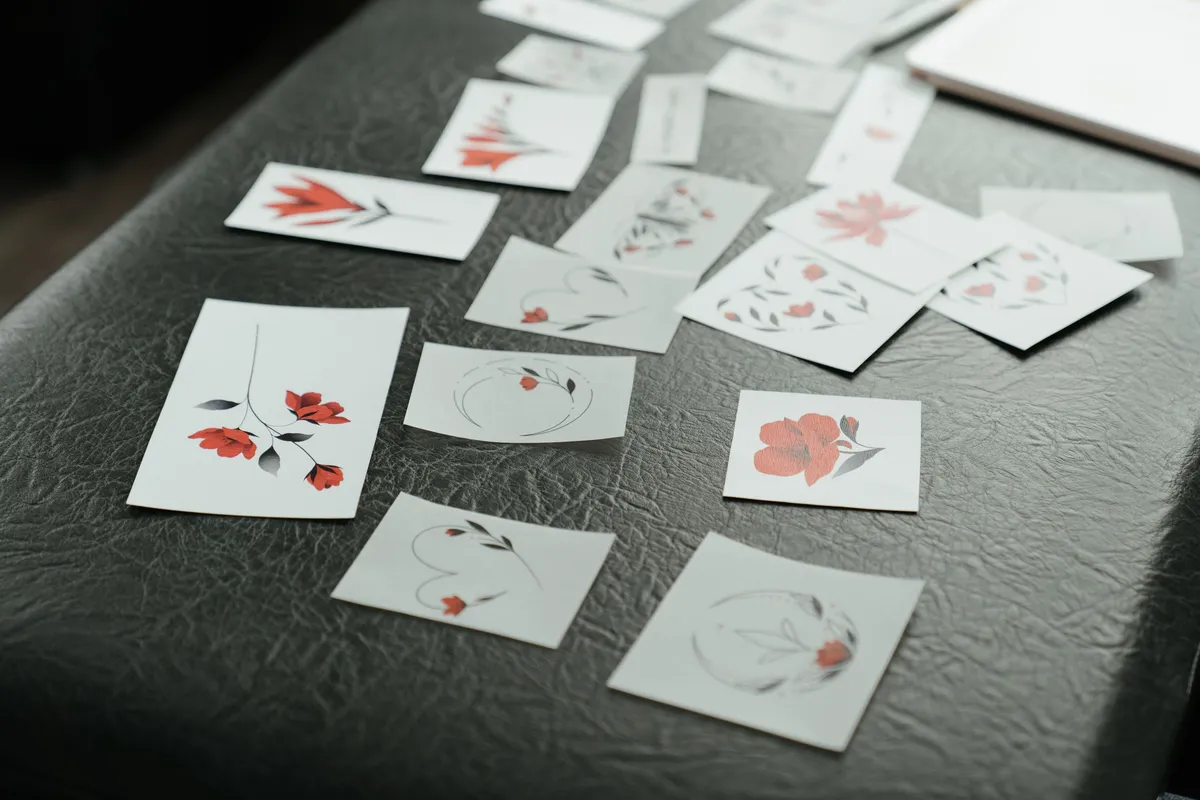
To try out a tattoo before getting it done for real, the easiest way is to apply a temporary version, in the right size and in the right place, and wear it for a few days. You’ll soon realise whether the design is too big, too small, in the wrong place, or exactly what you wanted. It’s quick, inexpensive, and it stops you from discovering a placement issue when it’s too late to change it.
Seeing a tattoo on a screen is nothing like seeing it on your own arm. On your phone, everything looks perfect. On your wrist, the same design can suddenly look like an extra watch.
How can you turn your design into a temporary tattoo?
The idea is simple: create a temporary version of the tattoo you’re considering, using your own design, and stick it onto the chosen area. A word, a date, initials, a symbol, an illustration: almost any design works.
Sites such as Wanapix, with whom we are collaborating on this article, allow you, for example, to create personalised temporary tattoos using your own image, so you can get a much clearer idea of the result before making a decision.
Three tips for a successful trial:
- a clear, high-contrast image: a blurry or too-pale image will result in rough outlines and distort your judgement;
- text that is legible at actual size: a font that looks elegant on screen may become illegible when printed at a size of three centimetres;
- Your tattoo artist’s consent if they have already designed your motif. Their design is a creation, and it is a matter of respecting their work.
Of course, the result will never be quite the same as a real tattoo done with a needle. But two key things will be clear: the size and the location.
Bigger or smaller?
Size is the most common mistake, and the easiest to avoid. A design that looks perfect on the screen often appears enormous on a forearm. Conversely, a small, discreet symbol you’ve imagined may seem lost once it’s been inked.
The solution: try out the same design in two or three different sizes. Look at them in the mirror, take photos, and show them to people around you if you like. A few centimetres can sometimes make all the difference.
Also bear in mind the passage of time. A tattoo changes as your skin ages: very fine lines thicken slightly, and small details become closer together. A design that’s already difficult to make out when it’s new will be even harder to see in ten years’ time. If your tattoo artist advises you to make it bigger, a test tattoo will help you visualise the new size.
How do you choose between several locations?
Are you sure about the design but not the location? The inside or outside of the forearm, the right or left wrist, the ankle or the calf: try the design in one spot, wear it for a few days, then try the other.
This is where the trial really comes in handy. You’ll see how the tattoo looks in real life, at work, at the gym, and with your everyday outfits. You’ll find out whether it disappears under your watch, whether it distorts when you bend your arm, or whether it makes you smile every time you catch a glimpse of it in the mirror. No photo edit will tell you that.
Our guide to tattoos by body part helps you narrow down your choices, and our pain map tells you what to expect for each one.
Stickers, henna, black henna: what really makes the difference
Not all temporary tattoos are created equal, and there is one type that should be avoided at all costs.
| Type | Approximate duration | To test a project | Good to know |
|---|---|---|---|
| Transfer sticker | A few days | Ideal | Sharp outline, applied in seconds |
| Natural henna (orange-brown) | One to three weeks | Less convenient | Long session times, expertise required |
| “Black henna” | Variable | Best avoided | Often contains PPD; risk of severe allergic reaction |
Why avoid black henna?
This is the safety aspect of this article, please read it right to the end. Temporary ‘black henna’ tattoos, often offered on beaches, at markets or in holiday resorts, are henna in name only. According to the ANSM, as reported by Vidal, their black colour and staying power come from a substance called PPD (paraphenylenediamine), which is illegally added to the mixture. In cosmetics, PPD is only authorised for use in hair dyes.
The consequences can be serious: allergic contact dermatitis, appearing a few days to a few weeks after the tattoo is applied, sometimes spreading beyond the tattooed area, and in the most severe cases requiring urgent medical attention. Furthermore, a sensitivity to PPD can last a lifetime.
If you experience a reaction after getting a temporary tattoo, consult a doctor. Service Public also reminds you that you can report any adverse reaction linked to a temporary tattoo product via the reporting portal, under the ‘cosmetics’ category.
To try out a tattoo design, stick to a sticker: it’s safer, quicker and looks much more like a real tattoo.
How do you apply a temporary tattoo so that the trial looks convincing?
A slapdash attempt yields a slapdash result. A few simple steps make all the difference:
- Clean and dry the area before applying the tattoo, without using any cream or oil, to ensure the design adheres properly;
- Place it in the limb’s natural position. A design stuck on with the arm outstretched may end up crooked when the arm is at rest;
- Check the orientation in the mirror, then look at it again without a mirror. Should a text be legible to you or to others? It’s a valid question, and one best answered by giving it a go;
- Take photos on the first day, when the design is clear, and then on the following days, wearing different outfits;
- Have a go at rating your impressions: on the third day, are you still enjoying looking at it, or have you forgotten all about it?
And if the trial session makes you change your mind about the design itself, so much the better. All three of us had to have our first tattoo touched up: believe us, avoiding a regret for just a few euros is the best value for money you’ll get from the whole project.
Should you do a skin test before applying the design?
It’s good practice, as with any product applied to the skin. Before applying a large design to a visible area, stick a small piece onto a discreet area, such as the inside of your elbow, and wait twenty-four hours. If any redness or itching develops, remove it and wash the area with lukewarm water. If the reaction persists or spreads, seek advice from a pharmacist or your doctor.
Why show your photos to your tattoo artist?
Because “roughly here, a bit higher” is a request that all tattoo artists are familiar with, and none of them appreciate. Photos of the design superimposed on the area, taken from various angles, show precisely the size, orientation and placement you have in mind.
Next, take their advice on board. A professional tattoo artist understands the anatomy of different body parts, how muscles move and how a design will age over time. If they suggest making adjustments, it’s to ensure your tattoo will still look great in twenty years’ time. To help you find the right artist, our guide to choosing your first tattoo sets out exactly what you need to check.
When should you have a trial session compared to your actual appointment?
Ideally, one to two weeks before the session, not the day before. This gives you time to wear the design in a variety of situations, suggest a modified version if necessary, and send the photos to the tattoo artist so they can prepare their stencil.
For a large design requiring several sessions, a trial design is even more valuable: it allows you to approve the overall layout before the very first outlining session, rather than discovering a disagreement over the placement once the work has begun. The template placed in the studio serves a similar purpose, but it only stays in place for a few minutes. A trial design done at home, on the other hand, stays with you for days.
How much does a trial session cost?
It’s a fraction of the cost of a real tattoo: a personalised temporary tattoo usually costs just a few euros. For a modest sum, you get information that you simply can’t obtain any other way before the session. When you consider the cost, time and commitment involved in a poorly placed tattoo, this is probably the best value for money investment in your whole project.
Just a quick try, no major doubts
Trying out a temporary tattoo doesn’t mean you’re having second thoughts. It means you’re taking your project seriously. Perhaps you’ll confirm exactly the idea you’ve had from the start. Perhaps you’ll discover it would look even better three centimetres higher. Either way, you’ll arrive at the studio with greater certainty, and your tattoo artist will have a much clearer brief. It’s a win-win for everyone.
Find out more
- How to choose your first tattoo (and get it right)
- Tattoos by body part: arm, ankle, ribs, nape of the neck
- 12 tattoo styles to choose from
Have you finalised your design, size and placement? All that’s missing now is the person who’ll make it permanent. To find a certified tattoo artist near you, view their portfolio and send them your test photos, download Tat’s It, the 100 per cent free app: the links are just below.
An idea, a tattoo, Tat’s It.